

Disclaimer: this article has been written 100% by me, a human being, using mechanical finger typing. All typos and lack of stylistic taste are entirely mine.
I haven’t taken to this blog for a year now. I changed jobs. I was busy with family matters. I got into a rabbit hole of tokenmaxxing building a coding harness for writing code I can trust with LLMs. And I took notes about things I wanted to write about, but I thought to myself that won’t be of any interest to anyone, so I didn’t write them. But in the end here we are, It thought maybe I would write something that would add some value to someone somewhere, and that would be worth reading instead of reading it from ChatGPT, Claude, or any of their derivatives.
So here we go. I’m worried. I’m worried for us.
I don’t want this to be yet another AI doomer article. I do believe AI can and will automate software engineering once we manage to solve the problem of ensuring code correctness with 5-nine reliability at scale. We will get there, it’s not about if but when.
I’m not worried about AI taking over as the paperclip maximizer. I’m worried about us humans losing our ways. Losing the simplicity of appreciating another human’s presence, giving a smile to someone without expecting anything in return, feeling someone’s skin and looking into his or her eyes as you shake hands. I’m worried that through addictive apps and AI interactions we are going to atrophy our ability to empatize with other living beings to the point of becoming a society of lonely self-absorbed narcissists with culturally ingrained sociopathic tendencies.
When COVID hit, in the first few weeks I was worried too. I wasn’t worried that the pandemic would kill everyone. I was worried of the impact it would have on people’s mental health due to the mass anxiety and the large scale isolation. And I think to a big extent my intuition was right.
I am not happy that I was right.
I really, really wish I was wrong.
I feel for the people who, as a result of isolation, are constantly depressed, distressed, in a state of deep despair, or have simply became addicted to online dopamine loops, or fallen prey to an internet cult or a radicalized subculture, and in the saddest cases, have hurt others or taken their own lives.
Individualism spred at scale with industrialization
It didn’t start with COVID. The industrialization process in the West and later in Asia pushed people into cities from their stable agrarian societies, that were strongly knitted and connected. Capitalist consumerism made it to possible to sustain one’s needs by spending one’s earned salary to buy those needs as commodities, such as food, clothing, and so on, without having to depend on others in a family or close circle, but by only having to perform a monetary transaction.
The family structures shattered, the system of villages that was offering protection and a sense of belonging, also shattered. We won’t rebuild that system, it’s gone. It’s gone forever. It took millennia to build, and it took a couple of generation to destroy. And for what? An industrialized existence, modernity, technology, and progress? I won’t challenge that vaccines have saved lives, and that took away most of child mortality and with it the unspeakable sorrow of losing a child, which in the past was something that a majority of humans had to experience. But are we really better off as a species because of the acceleration of modernity? Are we better humans than the ancient Greek thinkers who owned only the togas they wore on their backs, and didn’t have access to even an encyclopedia?
Another example are children. It’s exhausting to raise kids in the modern world, because you and your partner are on your own and you have to give them constant attention, and now that the double-income trap forces both parents to work, you have to work and raise your kids, and you are doing it without much support most of the time. Kids used to be raised not by parents mostly, but by the extended family, by the neighbors, and the community around, and that made it a lot easier to raise kids, and a lot less taxing. As the saying goes, “it takes a village to raise a child,” except the village isn’t there anymore, and it’s not coming back.
Then there was the decline of the third place, which is limiting people from having social interactions and creating bounds. In France for example, it was the cafés and bistrots, and in America it was shopping malls, bowling alleys, and diners.
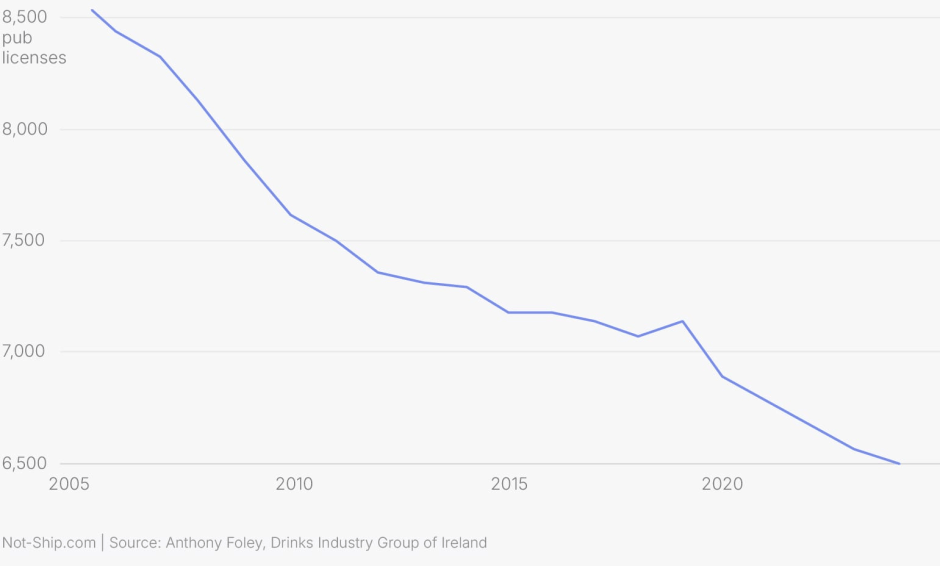
In Ireland, the pubs are dying.
Social media enter the chatroom
Then the internet happened, and with it the Web 2.0, with social media and apps designed for engagement, at the cost of harvesting our attention time to always sell more ads, with the side-effect of not spending time in person with other humans and further isolating us.
As it turns out, social media apps are all designed as variable-ratio schedules, something that was studied by J.F. Skinner, the father of operant conditioning and behaviorism. In plain English, it means social media are addictive because they’re designed like gambling machines, relying on hard-wired brain dopamine functions. I really recommend you read this 2001 article by a video game programmer at Microsoft to get an idea (make sure you also read page 2).
And while the rate of diagnosed anxiety disorders decreased until 2020 and rose only after COVID, the rate of self-reported anxiety has increased since 2010, with younger generations impacted the most.
Jonathan Haidt has been advocating that this increase in anxiety in younger generations is the consequence of addictive social media exposure, and whether you want to believe this is a correlation or a causation, I’ll leave it up to you. Nonetheless, you’ll have to admit that spending less time face-to-face with other humans, in dopamine loops driven by constant external validation, must have had an impact on the brain development of the generations that were born with it.
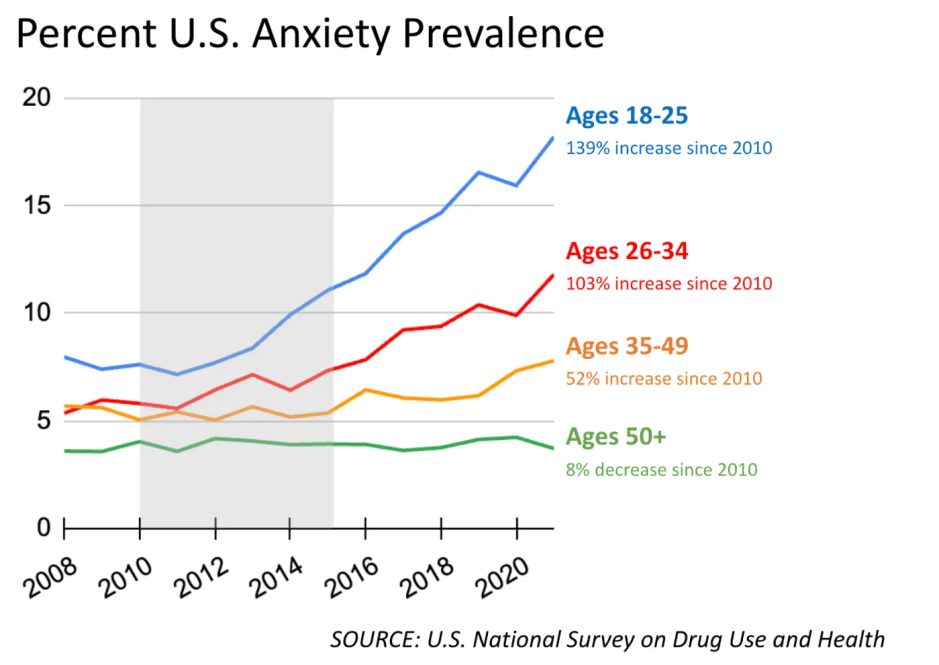

source: https://prefernp.com/a-comprehensive-look-at-anxiety-in-america/
Then there is this research that scanned a bunch of kids using an MRI, and showed lower microstructural organization in tracts responsible for language and reading, directly correlated with higher daily screen time. Other research points in the same direction.
Social media was sold to us as the tool that would help us stay connected with our loved ones all the time, but it the process of enshitification of the internet occurred, our habits with social media also shifted, and it’s now being used mostly for parasocial relationships and doomscrolling.

COVID was an accident along the way
A pandemic of the scale of COVID-19 was just waiting to happen, but that further added isolation and loneliness to the existing situation.
I saw in it myself. Going back to working in an office was not natural to me. I had a sort of mini social anxiety period in the first few months that I had to get over to really feel at ease in large groups. In-person meetings were more mentally taxing, the social and emotional information was too much for my brain to process at that point, I had to relearn being social.
And mind you, I’m one of the lucky ones: I forced myself to go back to the office, I made it through, I’m now back in the office four days per week. But there are people out there who are still “working from home” since COVID, and those people have never fully recovered their social skills, and many of them don’t realize.
There’s another weird thing I’ve noticed since COVID: people don’t talk to each other at the gym any more. I attribute that to the quarantine we went through. Now everybody has ear pods, avoids eye contacts, avoids talking to others, not trying to share a machine to train together, etc., it’s just weird. We’ve become a bunch of people who are constantly what I call “together alone.”
Poeple are spending more time alone
Over the past decade, people have been spending more and more time alone than with friends and romantic partners. Below is chart showing the trend for the U.S. population, for people aged 15 and older. There is an obvious sharp uptick at the start of the pandemic, but the trend has been very clear since 2013, therefore this isn’t something that’s only COVID related.

Source: https://www.washingtonpost.com/opinions/2022/11/23/americans-alone-thanksgiving-friends/ (mirror)
Boris Cyrulnik, a French ethologist and psychiatrist, has studied among other things the concept of resilience. His take is that modern societies misunderstand resilience as the idea that one becomes able to recover from hardness without relying on anything else than oneself, when on the opposite, resilience means being able to rely on others in order to be stronger and recover in the face of adversity, because there is no concept of self without a concept of other.
Cyrulnik’s work also covers how isolation slowly atrophies our brains, and makes us unable to find a life partner, unable to love, and unable to form lasting attachment. After all, isolation is one of the highest form of punishment that there is in high-security prison. People go insane in isolation.
Why talk to a human when AI tailors to your needs?
Now with AI, we are entering the realm of hyper-tailored experiences.
We used to play video games together, and now with AI, you can generate open worlds, NPCs, storylines, etc., everything on-the-fly and entirely tailored to your preferences and needs, without having to talk to any human and therefore without having to take the risk of being hurt, or even just offended, by another human, ever again.
And why would I play with you in your hyper-tailored video game universe when I can play in mine? We will soon be in little bubbles of our own, only playing single-player mode and not interacting with other players, further aggravating the isolation epidemic that we live in.
AI is persuasion bombing you, AI is manipulating you using rhetoric tricks, and if you have the predisposition for it, there is even this paper that shows that sycophantic AI decreases prosocial intentions and promotes dependence. But without having to go that far, AI can still be just another trigger for a gambling-like dopamine loop, fueled on tokkenmaxxing.
We were dealing with a content overflow and digital hoarding epidemic fueled by mass-scale dopamine addiction, and our solution to that as a species was to create a machine that generates an infinite amount of content, on demand, tailor-made, more addictive than cocaine, and that you can suck on like a water dispenser in a gerbil cage.
Multiple isolation sources are layering up into a cumulative effect
The bigger problem at play here, and the reason why I’m worried, is that all these changes in our ways of living are stacking up on top of one another, creating a cumulative effect engendering lonely and anxious humans with physically atrophied brains, at a scale we have never seen before.
Studies show via brain imagery that isolation and loneliness causes the brain to atrophy.
For example in this 2022 study, it was found that:
Persistent loneliness in midlife was associated with atrophy in brain regions responsible for memory and executive dysfunction, in other terms, those area of the brain become smaller, leading to cognitive decline, especially memory and executive function.
Lacking social connection is as negatively impactful for health as smoking 15 cigarettes per day.
AI cannot turn a profit, but it has already rewired attention
It’s still unproven whether AI can turn a profit for the world economy, and this has been at the center of many conversation with economists warning us about a bubble that would make the world go into another recession.
But maybe the money doesn’t matter.
One thing that is for sure is that people are spending less time on with friends and family, and also on social media or Netflix, because they are spending more time interacting with AI.
AI has been rewiring the attention economy, and maybe that’s all that matters. Because in the end, attention is just another currency that leads to power and fiat money. Now what does it mean to spend more time reading AI content and interacting with AI models rather than humans, and will be the effects to the human brain, that’s still to be stutied and discovered.
So, what’s the antidote?
I will finish this article like I started it. This is not yet another doomer piece. I just hope this helps bring awareness about some fundamental isolation issues we’re dealing with.
And I want to be optimistic about AI, because after all, you cannot stop progress. But I do wish we embrace it in a way that doesn’t require we sacrifice our humanity. I am hopeful that the newer generations will connect and be there for one another in ways that our generations failed at, because we weren’t inventive or tenacious enough.
Below is what I’m going to be focusing on for the coming years, It’s actually a list of very simple things, but they are hard because as humans, we always find the path of least resistance, we’re lazy, and we are generally bad at staying disciplined. I’ll write them here anyway, I hope they can be useful to you.
Cultivate friendships. Meet your friends regularly. And if you moved to a new city, sign up for clubs like sports, cooking, chess, theater, or whatever else it is that you’re into. Meet people in person. Talk to them. Listen to them. If you’re limited physically, or if you or some of your best friends moved far away, then schedule a recurring call every 2 to 6 months to make sure it happens.
Read, read, read. Don’t read more AI-generated content, but rather, read books written by humans, and if you can, then you should focus on the classics of philosophy. Use AI to generate a list of classic texts, or parts of books, in 40 pages of less, that’s disgestible. It’s all public domain, you can get .epub files for free and put that on your ereader. Then reflect about what you read, and use AI smartly, by expanding on the concepts and ideas that you’ve read about. The best is if you can find a friend to do this with, so you can talk to another human about what you’ve read and share what you’ve experienced and understood. Rinse, repeat. The classics can take you a lifetime to explore, there’s no excuse for not picking one.
Write, write, write. You don’t truly understand something until you’re able to write about it in simple language. Writing helps you structure your thoughts, and cement concepts and ideas. Having this blog has helped me a lot with doing this.
Practice NOSTDIN. This is Unix/Linux lingo, which stands for “no standard input.” Actively turn off devices for a while to reset your senses and dopamine receptors. Commute without a podcast to listen to. Stop using a social media app for a day, two, and then a whole week. Give your body and your mind time to heal.
Slow down. Learn to accept that you will not get everything that you have in mind done. Accept that you cannot research and know everything.
List your dopamine addictions and address them. What’s the app you’re always opening but shouldn’t? What are you doomscrolling? What’s the snack you’re always eating but shouldn’t. Get that under control. Even little reductions can have large effects.
Learn about history. Learn about the history of the country you are from, the country you live in, and the world cultures, eras, religions, and beliefs. Do not let others interpret the past and think for you.
Learn about logical fallacies. Learn to recognize logical fallacies in a text or a speech, so you are less susceptible to others’ thinking mistakes, but you can also recognize them in yourself when they happen.
Develop your critical thinking. The reading and writing above will get you covered. You’ve got to do it multiple times per week, or your brain will get mushy. TODO add resource.
Exercise. Train 3 times per week, 1 hour each time, at varying levels of intensity. See the recommendations from official national health agencies such as the NHS.
Learn about nutrition. Learn about macros, how to recognize unhealthy foods, how to cook healthy food. Prefer whole foods and avoid ultraprocessed food.
Be First to Comment